
Your Car's Maintenance Schedule, Explained

Confused by your owner's manual? Learn what each service interval means, why it matters, and what happens if you skip it.
Key takeaways
- Your owner's manual contains the most reliable maintenance schedule for your specific vehicle.
- Service intervals are based on miles driven, time elapsed, or whichever comes first.
- Skipping scheduled maintenance can cause minor wear to become expensive damage.
- Some tasks, such as checking fluid levels, are straightforward enough for most drivers to do at home.
- Severe-duty driving conditions call for more frequent service than the standard schedule.
What a maintenance schedule actually is
Every vehicle leaves the factory with a manufacturer-specified maintenance schedule. It tells you which fluids, filters, belts, and components need attention and how often. The schedule lives in your owner's manual, typically indexed by mileage and time side by side.
The two numbers work together. If the oil change interval reads "every 6,000 miles or 6 months, whichever comes first," a driver who covers only 3,000 miles in six months still needs to change the oil at the six-month mark. Oil degrades chemically even when a car sits, not just through use.
Manufacturers divide tasks into two tiers. Normal service covers typical highway and suburban driving. Severe service covers harder use patterns, such as frequent short trips, heavy loads, or extreme temperatures. Check which tier applies to your driving before assuming the longer interval is fine. Your owner's manual will list specific conditions that trigger the severe schedule.
Common service intervals and what they cover
Below are the intervals most drivers encounter. Exact figures vary by make, model, and engine, so always confirm against your manual.
- Engine oil and filter: Typically every 5,000 to 10,000 miles with synthetic oil. Older vehicles or those using conventional oil may require shorter intervals. This is the most frequent task on most schedules.
- Tire rotation: Usually every 5,000 to 7,500 miles. Rotating tires evenly distributes wear and can extend tire life noticeably.
- Cabin and engine air filters: Often every 15,000 to 30,000 miles, though driving in dusty areas shortens this. A clogged engine air filter can reduce fuel efficiency.
- Brake fluid: Many manufacturers recommend a flush every 2 years regardless of mileage, because brake fluid absorbs moisture over time and its boiling point drops as a result.
- Coolant flush: Commonly every 30,000 to 60,000 miles depending on coolant type. Degraded coolant loses its ability to prevent corrosion inside the cooling system.
- Spark plugs: Conventional plugs often need replacement around 30,000 miles. Iridium or platinum plugs can last 60,000 to 100,000 miles in many applications.
- Transmission fluid: Intervals range widely, from 30,000 miles on some automatic transmissions under severe duty to 60,000 to 100,000 miles for others. Some manufacturers label certain transmissions as lifetime-fill, though many independent mechanics disagree with that label for high-mileage vehicles.
For a plain-language guide to what these fluids actually do, see checking fluid levels at home. If any of the terms above are unfamiliar, our automotive glossary explains them without jargon.
Set a maintenance reminder today
Write your current mileage and today's date on a sticky note inside your glove box, then note the next service mileage and month beside it. Many free smartphone apps can also track multiple service intervals and send reminders. A simple system is easier to maintain than a complex one.
What skipping service actually costs you
Deferred maintenance rarely stays cheap. A $15 cabin air filter left in place for 60,000 miles does not fail catastrophically, but a neglected timing belt or low coolant level can. The cost difference between routine service and repairing the damage caused by skipping it is often significant.
$1,200+
Estimated cost of engine damage from oil sludge
AAA has reported that engine-related repairs from neglected oil changes are among the more costly results of deferred maintenance.
30%
Vehicles with underinflated or worn tires on the road
NHTSA data has indicated that a significant share of vehicles in operation have tires that are outside recommended condition, a factor often caught during routine maintenance inspections.
Oil sludge from extended change intervals can require an engine flush or, in severe cases, partial engine teardown. A missed coolant flush can allow internal corrosion to pit the water pump and radiator. Worn spark plugs increase fuel consumption and can eventually damage catalytic converters, which are expensive to replace.
Keeping a simple log of dates and mileage for each service, whether in a notebook or a phone note, makes it easier to stay on schedule and provides documentation if a warranty question comes up later.
How to read your owner's manual schedule
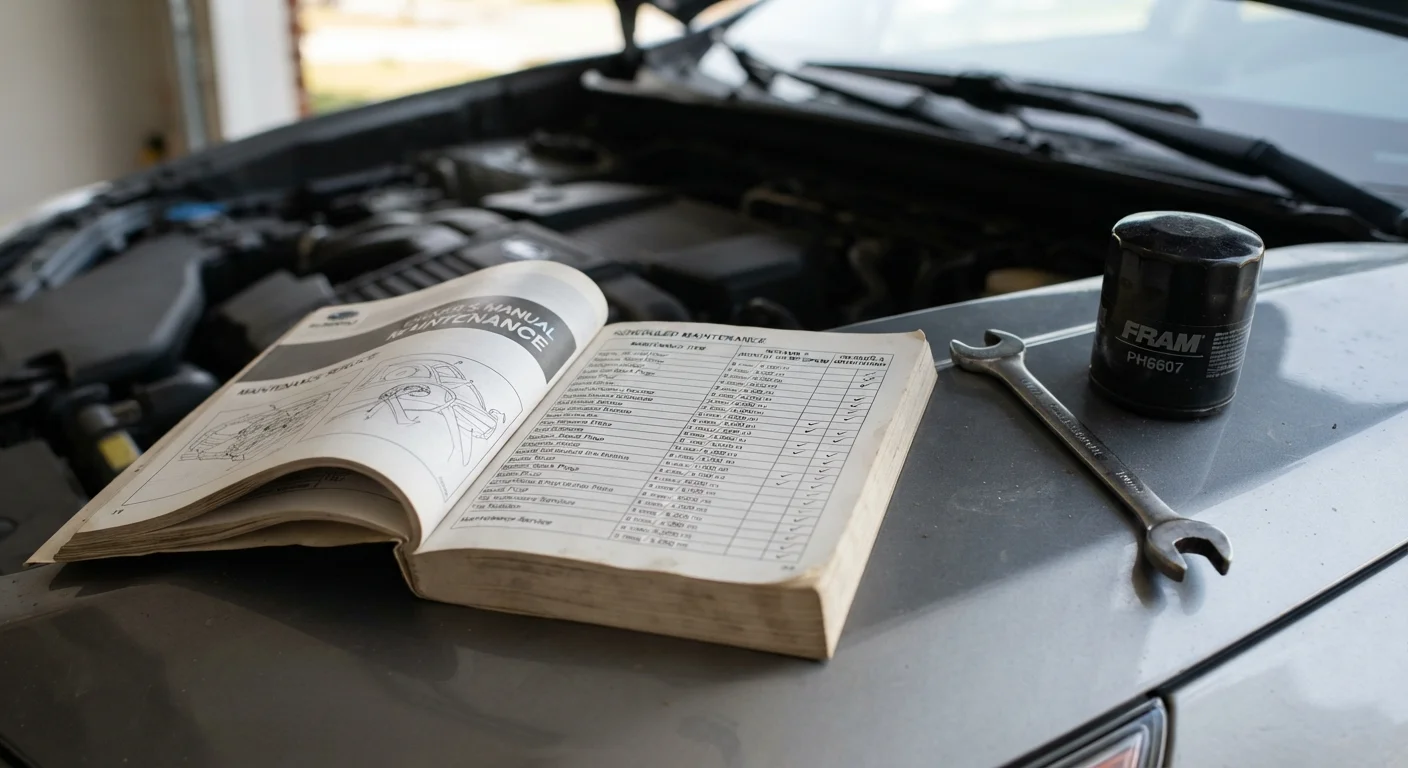
Open the manual to the maintenance section. You will usually find a table with mileage columns across the top and service items down the side, with check marks or letters indicating what is due at each interval. Some manuals use a lettered system, such as "Service A" and "Service B," that bundles multiple tasks together.
Pay attention to footnotes. A footnote might specify that a task applies only to turbocharged engines, only to vehicles operated in certain climates, or only if the car is used for towing. Skipping the footnotes is a common source of confusion.
If your manual is missing, most automakers publish them as free PDFs on their websites. You can also search by VIN (Vehicle Identification Number) to confirm the correct version for your specific vehicle.
Seasonally, certain checks overlap with scheduled maintenance. Our seasonal car care checklist covers what to inspect as the weather changes, which pairs well with your mileage-based schedule.
Choosing where to get service done
Once you know what your car needs, you can decide who does the work. Some tasks are straightforward enough to handle at home with basic tools. Others require specialized equipment or expertise. Our beginner's DIY maintenance guide identifies which jobs most drivers can safely tackle themselves.
For professional service, cost and quality vary between dealership service centers and independent shops. Our comparison of dealerships versus independent mechanics walks through when each option makes sense, including considerations around warranty coverage and specialty equipment.
Regardless of who does the work, keep every receipt. A complete service record protects you if a warranty dispute arises and adds value when you eventually sell the vehicle.
Frequently Asked Questions
The content provided on our blog site traverses numerous categories, offering readers valuable and practical information. Readers can use the editorial team’s research and data to gain more insights into their topics of interest. However, they are requested not to treat the articles as conclusive. The website team cannot be held responsible for differences in data or inaccuracies found across other platforms. Please also note that the site might also miss out on various schemes and offers available that the readers may find more beneficial than the ones we cover.