
Dealership Service Center vs. Independent Mechanic: Where Should Your Car Go?

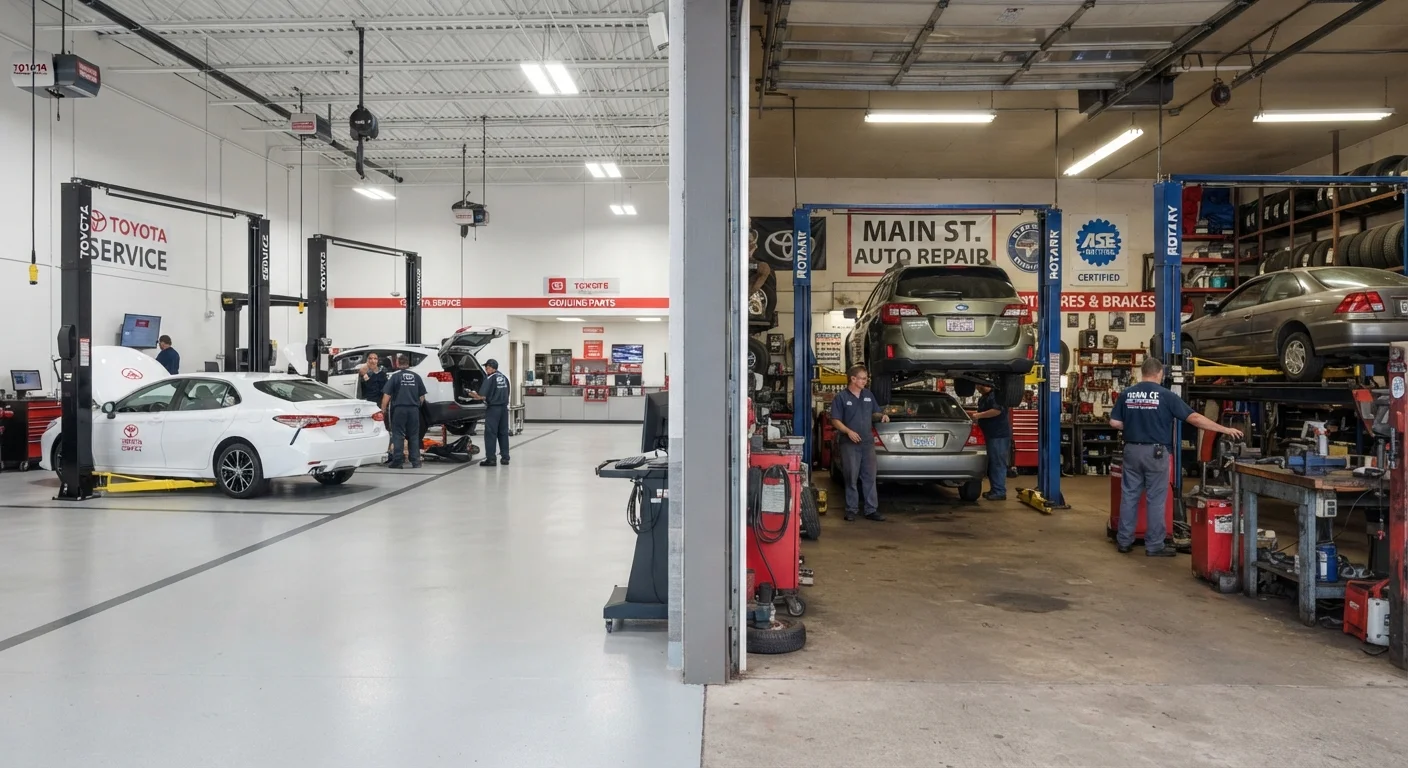
Weighing cost, convenience, warranty concerns, and expertise when deciding where to take your car for routine maintenance.
Option A
Dealership Service Center
The factory-trained, brand-specific option.
Best for: Drivers with newer vehicles under warranty or needing specialized diagnostics tied to a specific make.
Option B
Independent Mechanic
The flexible, often lower-cost alternative.
Best for: Drivers with older vehicles, routine maintenance needs, or a desire to build a long-term relationship with a trusted local shop.
Key takeaways
- Dealerships use factory-trained technicians and OEM parts, which matters most for complex, brand-specific repairs.
- Independent mechanics typically charge lower labor rates and can source aftermarket parts at reduced cost.
- Federal law (the Magnuson-Moss Warranty Act) means routine maintenance at an independent shop generally does not void a new-car warranty.
- For older, out-of-warranty vehicles, an independent mechanic is often the more cost-effective choice.
- Certifications such as ASE (Automotive Service Excellence) help identify qualified independent mechanics.
What you actually get at each type of shop
A dealership service center is staffed by technicians trained specifically on one brand. They have access to manufacturer-issued technical service bulletins (TSBs), proprietary diagnostic software, and original equipment manufacturer (OEM) parts. For recall work and warranty repairs, the dealership is the only authorized option.
An independent mechanic operates outside any brand arrangement. Many hold ASE certifications, meaning they have passed standardized tests across engine repair, brakes, electrical systems, and other areas. Independent shops can work on multiple makes, which gives them broad experience. They generally source parts from aftermarket suppliers or remanufactured stock, which reduces your bill without automatically reducing quality. See a plain-language glossary of common car care terms if terms like OEM or TSB are unfamiliar.
| Criterion | Dealership Service Center | Independent Mechanic |
|---|---|---|
| Labor rate | Higher (brand overhead) | Generally lower |
| Parts used | OEM (factory original) | Aftermarket or remanufactured |
| Technician training | Brand-specific factory training | ASE certification, multi-make experience |
| Warranty repairs | Required for covered claims | Not authorized for warranty work |
| Proprietary diagnostics | Full access to manufacturer tools | Limited or third-party tools only |
| Recall service | Performed at no charge | Not eligible to perform recalls |
| Relationship and continuity | Staff turnover varies | Often same technician over time |
| Best suited for | New or under-warranty vehicles | Older or out-of-warranty vehicles |
Cost differences and where they come from
Dealerships set their labor rates to cover higher overhead: specialized training, brand-certified equipment, and facility standards set by the manufacturer. Labor rates at dealerships are consistently higher than at most independent shops, sometimes by 30 to 50 percent or more depending on the region and vehicle brand.
Parts cost is the other variable. OEM parts carry a premium because they come through the manufacturer's supply chain. Aftermarket parts, which independent shops commonly use, range from budget-grade to quality-matched alternatives. Asking your mechanic which tier of aftermarket part they plan to use is a reasonable question, and a good shop will answer it plainly.
For routine jobs such as oil changes, tire rotations, and brake pad replacement, the independent shop almost always comes out cheaper. For a complex job tied to proprietary software, the dealership rate may be worth it to avoid a misdiagnosis. Small problems left unaddressed can become expensive no matter where you take your vehicle, so timely service matters more than the venue for minor issues.
Warranty: what the law actually says
Many drivers assume that having an independent mechanic change their oil or rotate their tires will void a new-car warranty. Federal law does not support that assumption. The Magnuson-Moss Warranty Act prohibits manufacturers from voiding a warranty solely because you used an independent shop for maintenance, provided the work was done correctly and documented. Keep your receipts and service records.
Where dealership service becomes genuinely necessary is for warranty repair claims: parts or systems that fail under the manufacturer's coverage must be diagnosed and replaced at an authorized dealer at no cost to you. Recalls fall in the same category. Outside those situations, routine maintenance by a qualified independent mechanic is legally protected. Check your vehicle's maintenance schedule to understand which services are required at each interval and keep records showing they were completed.
Keep your service records regardless of where you go
The Magnuson-Moss Warranty Act protects your right to use independent shops for maintenance, but documentation is your defense if a warranty dispute arises. Save itemized receipts showing the date, mileage, work performed, and parts used. A simple folder or a photo album on your phone works. If you ever sell the vehicle, a complete service history also supports the resale value.
How to evaluate an independent mechanic
The ASE certification is the most widely recognized credential in independent auto repair. Technicians who pass ASE tests in specific areas display those certifications, and shops with ASE-certified staff are a reasonable starting point. State-level licensing requirements vary, so check what your state requires of repair shops before you hand over your keys.
Ask the shop whether they use a written estimate before work begins, and confirm they will call you if the repair scope changes. A shop that gives you a written quote, explains what they found, and does not proceed without approval is operating with basic professional standards. Word-of-mouth referrals from neighbors or community groups remain one of the most reliable filters. Some routine tasks are simple enough to handle yourself, which also reduces how often you need to rely on either type of shop.
The content provided on our blog site traverses numerous categories, offering readers valuable and practical information. Readers can use the editorial team’s research and data to gain more insights into their topics of interest. However, they are requested not to treat the articles as conclusive. The website team cannot be held responsible for differences in data or inaccuracies found across other platforms. Please also note that the site might also miss out on various schemes and offers available that the readers may find more beneficial than the ones we cover.