
Laminate Flooring vs. Vinyl Plank: What Budget Renovators Should Know

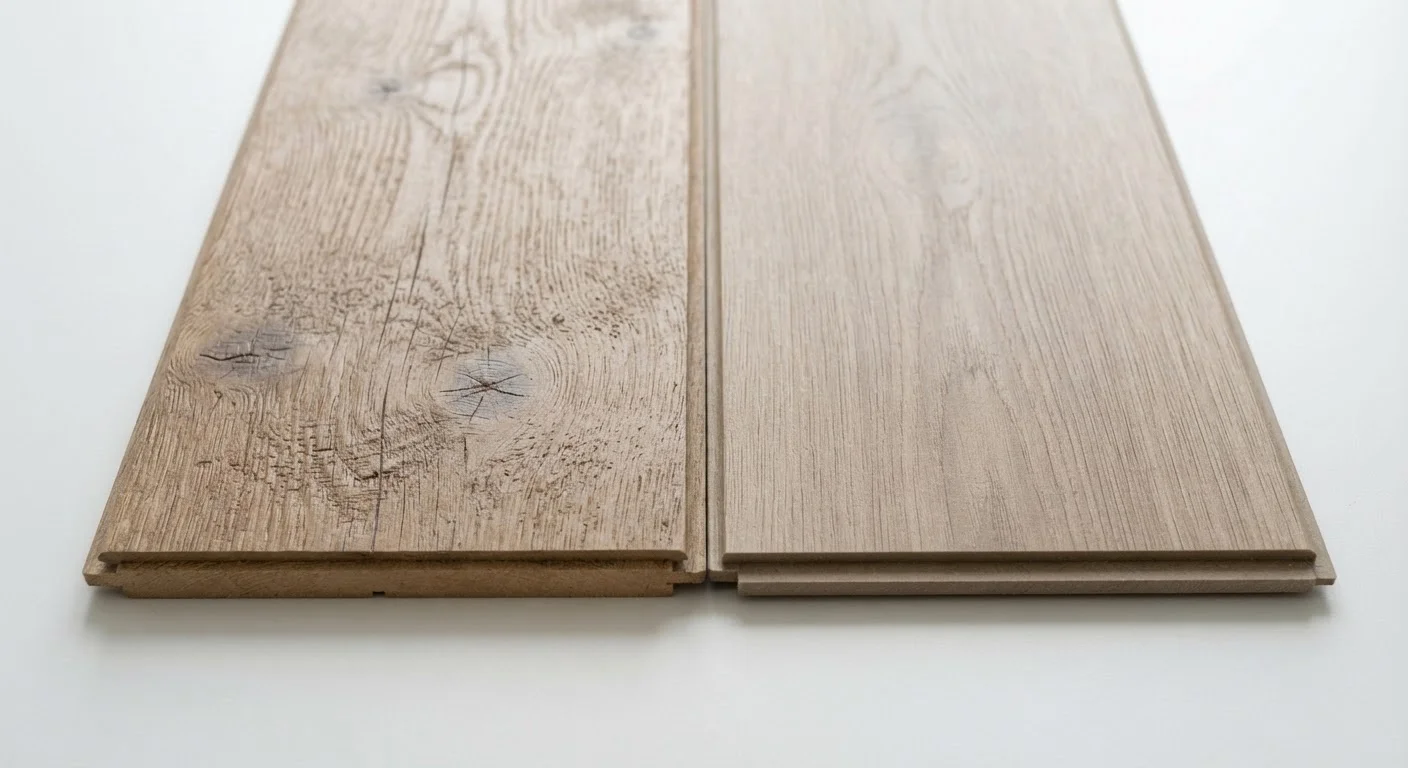
Laminate and vinyl plank flooring look similar at a glance but behave very differently underfoot, under moisture, and under foot traffic.
Option A
Laminate Flooring
The wood-look workhorse for dry interior spaces.
Best for: Budget renovators who want a realistic hardwood appearance in living rooms, bedrooms, and hallways with low moisture exposure.
Option B
Vinyl Plank Flooring
The waterproof, flexible option for high-traffic and damp areas.
Best for: Families who need a durable, moisture-resistant floor in kitchens, bathrooms, basements, or rental properties.
Key takeaways
- Vinyl plank is waterproof; laminate is only water-resistant and can swell when exposed to standing moisture.
- Laminate typically feels harder underfoot, while thicker vinyl plank absorbs more sound and slight subfloor imperfections.
- Both products cost roughly $1 to $4 per square foot for materials at the entry level, but installation conditions differ.
- Laminate cannot be installed in bathrooms or below grade without significant moisture mitigation measures.
- Vinyl plank is more forgiving on uneven subfloors, which can reduce prep costs for budget renovators.
What each product actually is
Laminate flooring is a composite product. A high-density fiberboard (HDF) core is topped with a photographic layer printed with a wood or stone image, then sealed under a clear wear layer. Because the core is wood-based, it absorbs moisture over time and can swell, warp, or separate at the seams.
Vinyl plank flooring, often sold as luxury vinyl plank (LVP), uses a plastic core, typically polyvinyl chloride (PVC) or a stone-plastic composite (SPC). The wear layer and printed design sit on top, just as with laminate, but the core does not absorb water. That one structural difference drives almost every performance distinction between the two products.
Both install as floating floors using click-lock systems, which is why they look identical in-store and why shoppers often confuse them. Neither requires adhesive in most residential applications.
Cost comparison for budget renovators
Material prices at the entry level run similarly for both: roughly $1 to $3 per square foot for laminate and $1.50 to $4 per square foot for vinyl plank, depending on thickness and wear-layer rating. Thicker vinyl plank (8mm and above) costs more but performs better in high-traffic areas.
| Criterion | Laminate Flooring | Vinyl Plank Flooring |
|---|---|---|
| Core material | Wood-based HDF | PVC or stone-plastic composite |
| Water resistance | Water-resistant only | Fully waterproof |
| Entry-level material cost | $1 to $3 per sq ft | $1.50 to $4 per sq ft |
| Suitable for bathrooms | Generally not recommended | Yes |
| Suitable for basements | Requires strict moisture control | Yes, with proper installation |
| Subfloor tolerance | Must be very flat and dry | Tolerates minor irregularities |
| Sound underfoot | Can sound hollow without underlayment | Quieter, especially at 8mm+ |
| Realistic wood texture | Deeper embossing at similar price | Good, less emboss depth at low price |
Where costs diverge is in subfloor preparation and room conditions. Laminate requires a flat, dry, and acclimated subfloor. If your subfloor has moisture readings above manufacturer thresholds, you will need a vapor barrier or remediation work before installation, adding cost and time. Vinyl plank, particularly SPC-core products, tolerates minor subfloor variation and higher ambient humidity without those extra steps.
Installation labor runs $1.50 to $3 per square foot for either product when hired out, but both are realistic DIY projects for a homeowner comfortable with basic measuring and cutting tools.
Durability and performance in real households
Laminate wear layers are rated by an AC (abrasion class) number. AC3 is adequate for residential use; AC4 and AC5 handle heavier traffic. Scratches from pet claws and furniture legs are the most common complaint, and laminate scratches cannot be repaired in place. A damaged plank must be replaced.
Vinyl plank wear layers are measured in mils (thousandths of an inch). A 12-mil wear layer is a reasonable residential minimum; 20 mil and above is worth considering in high-traffic kitchens or entryways. Vinyl is generally more resistant to dents and surface scratches than laminate at the same price point.
Sound transmission differs noticeably. Laminate clicks and sounds hollow underfoot, particularly without a quality underlayment. Vinyl plank, especially thicker SPC products, deadens sound more effectively. Pre-attached underlayment on some vinyl plank products can reduce that cost further.
12 mil
Minimum vinyl wear layer for most residential use
Flooring industry guidance generally positions 12-mil wear layers as the entry point for household foot traffic durability.
AC3
Laminate abrasion class for standard residential rooms
The European Producers of Laminate Flooring (EPLF) scale rates AC3 as appropriate for moderate residential traffic, with AC4 suited to heavy use.
$1 to $3
Typical entry-level laminate cost per square foot
Material-only pricing varies by region and product line; installation labor and underlayment are additional costs not included in this figure.
Neither product handles prolonged direct sunlight well without UV-protective window film, as both can fade and expand from heat. This is worth planning around in sunroom installations.
Where each floor belongs in your home
Laminate belongs in dry, above-grade rooms: living rooms, dining rooms, bedrooms, and hallways where moisture is not a regular factor. It should not be installed in bathrooms, laundry rooms, or below-grade basements without consulting the manufacturer's specific moisture guidelines, and even then the risk of long-term swelling is real.
Vinyl plank can go almost anywhere: bathrooms, kitchens, basements, mudrooms, and even over in-floor radiant heat in many cases (check the product's temperature rating before installing over radiant systems). That flexibility makes it the practical default for whole-home renovations where multiple room types are involved.
If you are mixing flooring across a renovation, using vinyl plank throughout a main floor simplifies transitions and moisture management. Using laminate only in bedrooms and hallways where moisture risk is low is a reasonable cost-saving approach.
This article is for general informational purposes only. Material costs, subfloor requirements, and installation conditions vary by region, product, and building. Consult a licensed flooring contractor and verify local building codes before beginning any renovation project.
The content provided on our blog site traverses numerous categories, offering readers valuable and practical information. Readers can use the editorial team’s research and data to gain more insights into their topics of interest. However, they are requested not to treat the articles as conclusive. The website team cannot be held responsible for differences in data or inaccuracies found across other platforms. Please also note that the site might also miss out on various schemes and offers available that the readers may find more beneficial than the ones we cover.