
Envelope Budgeting vs. Zero-Based Budgeting for Households

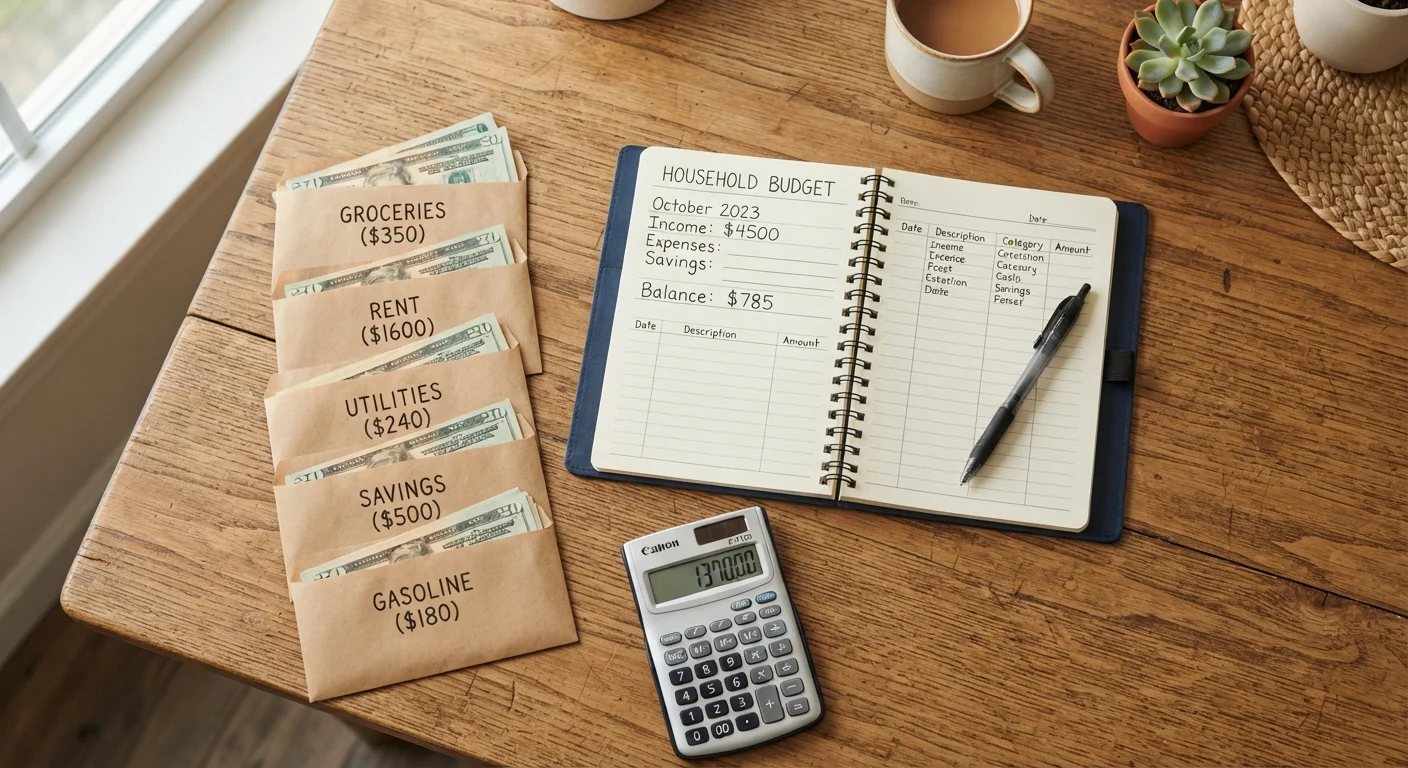
Two popular cash-management methods compared side by side so families can decide which approach fits their spending habits and lifestyle.
Option A
Envelope Budgeting
The tactile, cash-in-hand spending system.
Best for: Households that overspend in specific categories and want a physical boundary on discretionary cash.
Option B
Zero-Based Budgeting
The plan-every-dollar, income-minus-expenses approach.
Best for: Households comfortable tracking digitally who want full visibility across all spending categories at once.
Key takeaways
- Envelope budgeting works with physical cash divided into labeled spending categories each pay period.
- Zero-based budgeting assigns every dollar of income a job until the balance reaches zero on paper.
- Both methods require knowing your monthly income and fixed expenses before you start.
- Envelope budgeting creates hard stops on overspending; zero-based budgeting allows more flexibility across categories.
- Mixing digital tools with either method is possible, though envelope budgeting loses some of its friction-based benefit.
- Neither method guarantees savings growth without a category specifically set aside for saving.
How each method works
Envelope budgeting starts with cash. At the beginning of each pay period, you withdraw your planned spending money and divide it into labeled envelopes: one for groceries, one for gas, one for dining out, and so on. When the cash in an envelope runs out, spending in that category stops. No transfers, no exceptions. The physical act of handing over bills makes each purchase feel concrete in a way that a card swipe does not.
Zero-based budgeting works on paper or a spreadsheet rather than in your wallet. You list your total monthly income, then assign every dollar to a category, including savings and debt payments, until the unassigned balance hits zero. The name does not mean you spend everything; it means every dollar has a named purpose before the month begins. If income is $4,800, your category totals must add up to exactly $4,800. Any dollar without a job is a gap in the plan.
Both methods are explained in more detail in our overview of how household budgets work, which is a useful starting point if you are new to structured spending plans.
| Criterion | Envelope Budgeting | Zero-Based Budgeting |
|---|---|---|
| Medium | Cash, envelopes, pen | Spreadsheet or app |
| Setup time | 30 minutes or less | 1 to 2 hours first month |
| Covers all spending? | Discretionary categories only | Every dollar of income |
| Works for online spending? | Requires workarounds | Yes, fully |
| Hard stop on overspending? | Yes, cash runs out | No, requires self-discipline |
| Good for variable income? | Less flexible | More adaptable each month |
| Savings integration | Needs a dedicated envelope | Built in as a named category |
Practical trade-offs for families
Envelope budgeting's biggest strength is also its constraint. Cash is harder to carry for online purchases, automatic bill payments, or subscriptions. Families who pay rent, utilities, and insurance by bank transfer need a hybrid approach: use envelopes only for discretionary categories and handle fixed bills separately. That workaround is workable, but it means the method covers only part of the budget.
Zero-based budgeting covers the whole picture, but it demands more upfront effort. Building a complete category list takes time, and the plan needs to be rebuilt from scratch whenever income or a major expense changes. For households with variable income, that monthly rebuild can feel like a recurring chore. However, it also produces a clearer record of where money went, which makes the monthly financial check-in much faster.
Overspending patterns are worth considering too. If one or two categories routinely blow the budget, the hard stop of an empty envelope tends to be more effective than a spreadsheet cell showing a negative number. For households carrying debt, zero-based budgeting integrates debt payments as a named category, which connects naturally to the strategies in our article on balancing debt payoff with saving.
Getting started with either approach
Before choosing a method, gather two numbers: your household's average monthly take-home income and your fixed monthly expenses (rent or mortgage, insurance, loan minimums, utilities). Those numbers are the foundation either method builds on. Our plain-language guide to budget terms explains concepts like fixed vs. variable expenses if any of that language is unfamiliar.
For envelope budgeting, list four to six variable spending categories where you want hard limits. Withdraw that combined cash amount on payday, divide it, and track nothing else digitally. For zero-based budgeting, open a spreadsheet, list every income source, then list every category you spend in, including irregular ones like car maintenance and holiday gifts. Assign dollar amounts until the two columns match. Adjust category amounts, not totals, when something changes mid-month.
Both methods improve with consistent monthly review. Tracking where money actually goes is easier once you have a method in place, because you already have categories to match spending against.
This article is for general informational purposes only and is not personalized financial advice. Consult a qualified financial professional before making decisions specific to your household's situation.
The content provided on our blog site traverses numerous categories, offering readers valuable and practical information. Readers can use the editorial team’s research and data to gain more insights into their topics of interest. However, they are requested not to treat the articles as conclusive. The website team cannot be held responsible for differences in data or inaccuracies found across other platforms. Please also note that the site might also miss out on various schemes and offers available that the readers may find more beneficial than the ones we cover.